Like most industries, the printing and packaging industry has terminology and a vernacular all its own. If this is your first time designing packaging or working directly with a packaging manufacturer, you may find yourself needing a little help to understand the unfamiliar words and phrases from time to time.
Often, in order to fully understand trade vocabulary, you must also become educated about the objects, actions, and processes it describes. Such is the case with the term dieline—a word you will undoubtedly hear tossed around many times throughout your packaging design and manufacturing journey.
In this post, we will define and demystify dielines as well as explore how they are designed and their importance in creating a precise, functional, and attractive finished product. If you still have questions about dielines after reading this post, a knowledgeable SupremeX team member will be happy to further educate you.
What Is a Dieline?
As an industry outsider, you might be forgiven for imagining that a dieline has something to do with destroying lines, but you’d be wrong.
In actuality, a dieline refers to a packaging template or blueprint.
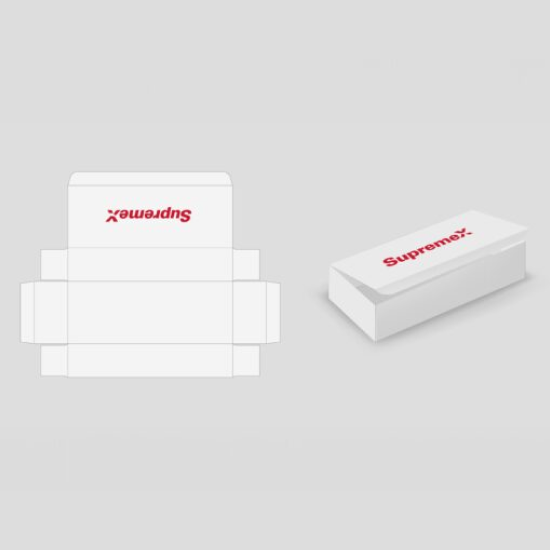
A dieline is a two-dimensional diagram that helps to ensure a packaging design’s layout and dimensions are correct before it goes into production. If you take an empty cereal box (or other folding carton) and carefully unfold it until it is completely flat, you’ll gain a good sense of what one looks like.
Created using specialized software, dielines indicate the size and shape of a packaging design as well as where folds, perforations, and cuts will be added. Dielines create a precise guide for die-cutting machines to follow during the manufacturing process.
Defining Dielines
If you’re not used to looking at dielines, you may initially be confused when you first encounter one. This is because viewing a three-dimensional package in two dimensions means that you’ll see all of its tabs and surfaces at once. In some cases, graphics or text (if present on the dieline) may not appear “right side up”.
With a little practice, however, you’ll soon get used to interpreting dielines and will be able to visualize the finished product quite easily. You will also begin to recognize what is indicated by the various types of lines on the template.
Types of Lines in the Dieline
A dieline may appear to be a roadmap crisscrossed with different colored lines. Indeed, as with a real roadmap, each type and color of line represents something different.
Fold Lines – Fold lines indicate where precise folds will give your box the shape and dimensions you envision. Some fold lines are perforated, while others are not.
Cut Lines – Cut lines indicate where the die-cutting machine will punch out your packaging’s shape (much like a massive, exceptionally sharp, and highly customized cookie cutter). They determine what packaging material will remain to be folded and glued and what will be recycled.
Dotted Perforation Lines – Perforation lines can be used to create punch-outs or tear-off strips that customize packaging to create a positive and functional user experience (e.g. a punch-out that allows a product to be poured out of a box or a perforation that makes it easier to quickly tear open packaging).
Bleed Lines – Not to be confused with safety lines (see below), bleed lines provide a boundary for graphic elements, such as background colors and images. Bleed lines actually extend beyond cut lines and will be cut off in the die-cutting process. This is intentional and ensures that no unprinted edges will be visible in the final packaging.
Safety Lines – Safety lines indicate the boundary that important artwork and design elements must not cross. Nothing within the safety lines should be at risk of being lost during the trimming process.
Glue Tabs – Glue tabs indicate where glue or adhesive should be applied during the manufacturing process to hold your packaging together.
Why Dielines Are Important
Dielines are the blueprint that will bring your packaging vision to life and, as such, are critically important for many reasons:
- They communicate the sizing, scale, and dimensions of your finished product.
- They ensure the correct location for all visual elements such as graphics, images, text, and embellishments.
- They provide an accurate template for where folds, cuts, perforations, glue tabs, and other connection points should be added.
- They incorporate any custom information and bleed requirements.
From a less technical perspective, die lines also offer you the first peek at what your finished packaging design will look like and are often highly anticipated. Once a dieline has been approved, a packaging prototype may be ordered for final proofing before production gets fully underway.
Who Creates the Dieline
Dielines are generally created by packaging designers whose expertise helps to minimize errors and expedite the overall production process. If you are new to the world of packaging design or do not have an in-house creative team, our skilled and experienced packaging design team will be happy to offer guidance and support.
Dieline Requirements
Dielines may seem relatively straightforward, and conceptually they are. But if you want to try your hand at designing one of your own, there are some important requirements you’ll need to know about. These include:
- Dielines must be designed using mathematically described lines that can be interpreted by computers and machinery. They must be created in the format known as vector art, and cannot simply be designed using standard graphic design software. Most dielines are designed in specialized computer aided design (CAD) programs.
- Before creating an InDesign document, it is imperative to know the exact size specifications of your dieline. This will save you time, money, and frustration down the road.
To learn more about dieline requirements, reach out directly to our dedicated team at SupremeX.
Looking To Order Custom Packaging?
As you begin your custom packaging journey, you will undoubtedly find yourself with many questions along the way. Hopefully, this post has given you a better understanding of dielines, but you may still be wondering about many other print and packaging industry terms and processes. We’re here to help.
At SupremeX, exceptional customer service is a top priority and we are always available to offer support and guidance as you navigate the packaging design process for the first time or the thousandth.
Are you ready to start creating dielines and get your custom packaging project underway? So are we.
Reach out to us directly today to begin the process!