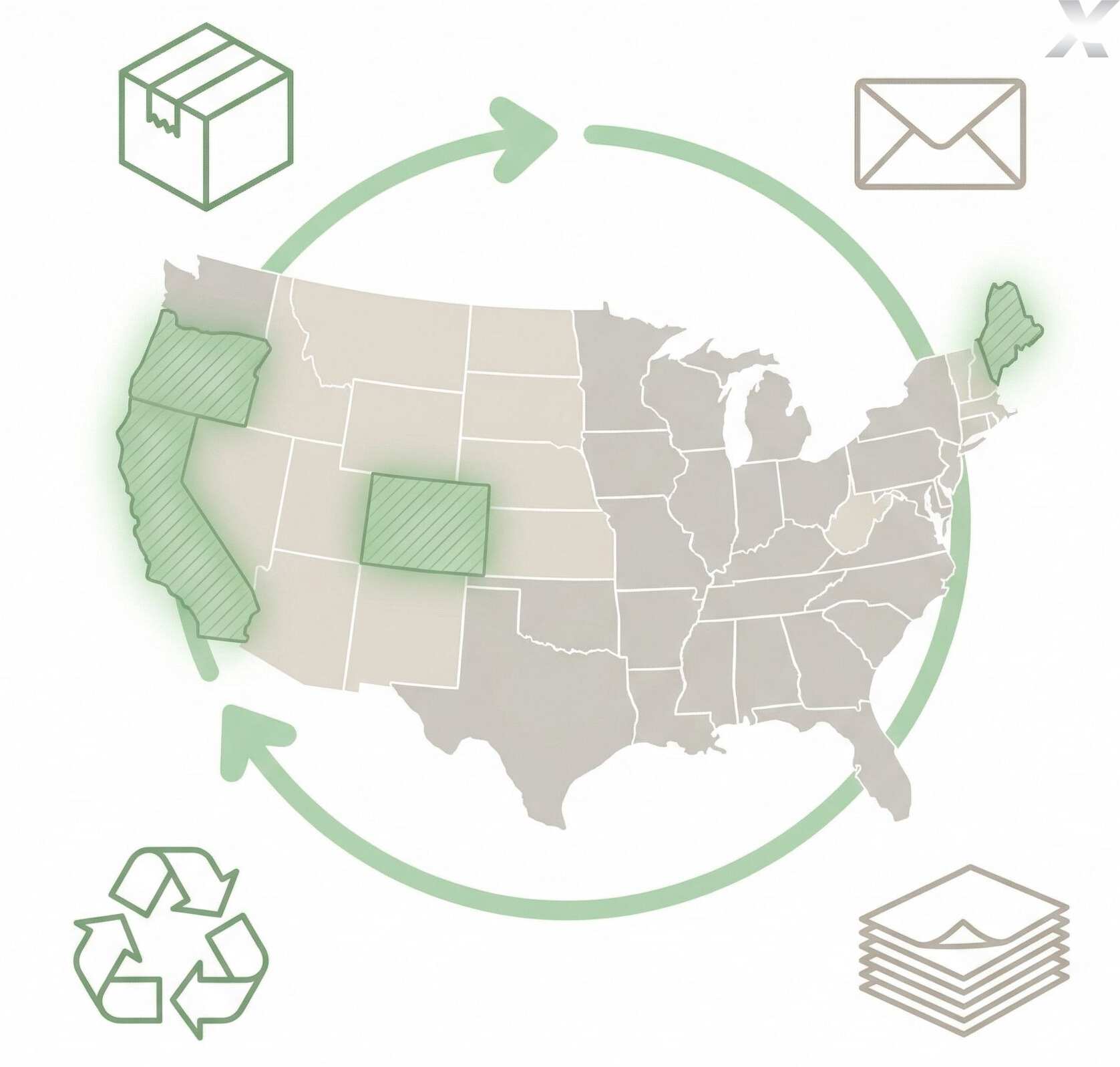
Extended Producer Responsibility (EPR) is no longer just a “nice to have” in global sustainability conversations — in the United States, it’s becoming a real force, too. While there’s no national EPR law yet, a growing number of state-level programs are reshaping how companies that produce, import, or sell packaged goods must think about waste, recycling, and end-of-life responsibility.
For businesses operating in the U.S. (or planning to), understanding this patchwork of EPR regulations is critical. This post breaks down where things stand today, key state programs, and what brands need to do to be ready.
What EPR Looks Like in the U.S.
Unlike many countries that adopt a single national law, EPR in the U.S. is regulated at the state level.
- As of 2025, seven U.S. states have enacted packaging-specific EPR laws: California, Colorado, Maine, Maryland, Minnesota, Oregon, and Washington.
- Each of these states has its own EPR model, covering different materials, targeting different outcomes, and using different timelines.
- Producer (“obligated company”) definitions vary by state — but typically include companies that manufacture, import, or brand packaging sold in the state.
Key State Programs & Timelines
Here’s a breakdown of some of the most important EPR programs in the U.S. right now, and what producers need to watch out for.
Maine
- Maine was the first U.S. state to pass a packaging EPR law (LD 1541).
- Under this law, producers pay into a “stewardship organization,” which helps reimburse municipalities for recycling program costs.
- There is a small-producer exemption, but fees are generally based on the “amount and recyclability” of packaging sold.
Oregon
- Oregon’s EPR law is part of the Recycling Modernization Act (RMA).
- Key dates: producers needed to register by March 31, 2025, and fee payments begin around July 1, 2025.
- Oregon’s system includes performance targets for recycling: for example, a 25% recycling rate by 2028, 50% by 2040, and 70% by 2050.
California
- California’s law is called the Plastic Pollution Prevention and Packaging Producer Responsibility Act (SB 54).
- The law is ambitious: by 2032, all single-use packaging in the state must be either recyclable or compostable, and at least 65% of single-use plastic packaging must actually be recycled.
- Key compliance steps:
- Producers must register with the Circular Action Alliance (CAA).
- Reporting of packaging data begins before 2027.
- A fee schedule (eco-modulated) will be used to incentivize more sustainable packaging.
Colorado
- Colorado’s Producer Responsibility Program for Statewide Recycling (HB 22-1355) targets packaging and paper products.
- Critical dates:
- Data reporting due: July 31, 2025
- Fee collection begins: January 1, 2026
- The law is designed to expand equitable recycling access, including rural communities.
Minnesota
- Passed its Packaging Waste and Cost Reduction Act (HF 3911) in 2024.
- Producers must register with a PRO by July 1, 2025.
- The law has multi-year “cost coverage” ramp-up: producers will gradually pay more of the system’s costs over time.
Maryland
- Maryland’s EPR law (SB 901) was signed more recently.
- Important timelines:
- Producer plans due: April 1, 2027
- Producers to cover 50% of program costs: by July 1, 2028 → then 75%, then 90% in subsequent years.
Washington
- Washington’s Recycling Reform Act (SB 5284) was passed in 2025.
- Deadlines in the law:
- Producer registration: July 1, 2026
- The PRO needs to submit its plan: October 1, 2028
- Fee coverage targets ramp up: 50% by 2030, 75% by 2031, 90% by 2032.
- Unique feature: the law includes support for reuse systems, not just recycling — and producers (or PROs) will fund reusable packaging development.
Why These U.S. EPR Programs Matter for Business
If your company sells products in one or more of these states, EPR could significantly affect you:
- New Reporting & Registration Obligations
You may need to report packaging data (type, weight, recyclability), register with a PRO, and pay fees based on your product mix. - Eco-Modulated Fees = Design Incentives
Many states use “eco-modulated” fee structures: packaging that’s more recyclable or made with lower-impact materials often incurs lower fees. - Cost Implications
The costs linked to EPR are real — ranging from reporting and registration to financial contributions. But they can be mitigated by smart packaging design. - Regulatory Complexity
Because there’s no national law, companies may face seven (or more) different state systems, each with unique definitions, requirements, and timelines. - Opportunities for Innovation
- Use of recyclable, reusable, or compostable materials
- Redesign to reduce packaging weight or complexity
- Leverage EPR as a brand differentiator (sustainability, transparency)
- Risk of Non-Compliance
Missing registration, reporting, or fee deadlines could lead to penalties — and potentially restricted market access in states with EPR laws.
Strategic Recommendations for Businesses
Here are some actionable steps companies should take now to navigate the U.S. EPR landscape:
- Audit Your Exposure: Identify which states you sell into, and which have active or pending EPR laws.
- Engage with a PRO: Many states require producers to work with a Producer Responsibility Organization. Engage early to understand the plan and fee methodology.
- Gather Data: Start collecting internal data on packaging types, weight, material composition, and sales volumes — this will form the basis for reporting and fee calculation.
- Design Strategically: Work with your packaging team (or partners) to optimize materials for recyclability, reduce unnecessary packaging, and explore reusable packaging models.
- Budget for Fees: Forecast your EPR-related costs — treat them like a compliance cost line item in your sustainability or operations budget.
- Track Implementation Milestones: Stay on top of state-level regulatory developments, PRO plan submissions, and reporting deadlines.
EPR is no longer just a European or Canadian conversation — it’s very real in the U.S., too. Across multiple states, producers are now being held accountable for the end-of-life impact of their packaging. For brands, this means new responsibilities, costs, but also serious opportunities to innovate, reduce waste, and lead in sustainability.
If your business isn’t already mapping its exposure to U.S. EPR programs, now is the time. The regulators, PROs, and markets are moving fast — and the companies that move with them will be best positioned for success.